
What players say
Cooperative Maze Puzzle Adventure succeeds by making teamwork structural rather than optional: switches and timed sequences force players to plan together. The keyboard-only controls and reset function keep the barrier low, and the family-friendly presentation suits mixed-age groups. The main limitation is that solo play is not viable, so the experience depends entirely on having a reliable group to coordinate with.
About this game
Team-First Puzzle Design
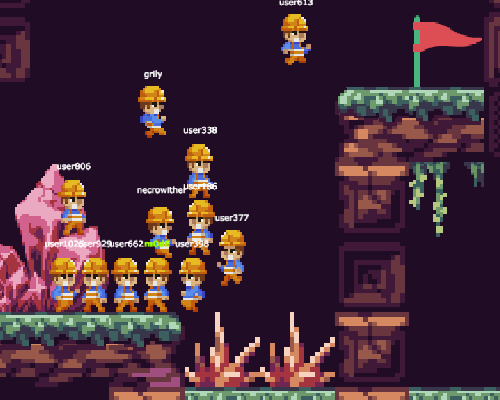
Every stage in Cooperative Maze Puzzle Adventure is built so that no single player can solve it alone. Obstacles require two or more people to act at the same time — flipping switches together, timing a jump, or holding a path open while someone else crosses. The maze layout and logic puzzles are interwoven: you are not just finding a route, you are negotiating who does what and when. Individual reflexes matter less than the group's ability to share what they see and agree on a plan.
How Levels Teach and Escalate
Early stages keep things simple: basic navigation and single switch activations establish the rhythm of call-and-response. Later stages layer in sequences that demand tighter timing and a clearer division of roles, with mazes shifting between open rooms and narrow corridors. Because each new element builds on the last, the difficulty curve feels like a series of lessons rather than sudden spikes. A completed puzzle is the visible result of the team's combined effort, which gives progression a social weight.
Controls and Accessibility
The control scheme is deliberately narrow — keyboard inputs for movement and jumping only. That simplicity lowers the barrier for younger players and anyone new to puzzle games. A reset function lets a stuck player restart their position without forcing the whole team to begin again, which keeps frustration low and encourages trying unconventional solutions.
Communication as a Core Mechanic
Because puzzles cannot be solved in isolation, discussion becomes part of the gameplay loop. Players describe what they see, propose a sequence, and adjust when a plan fails. The design rewards trust and clear role assignment, and it naturally gives every participant something useful to contribute. Sessions tend to feel different from one another depending on how the group communicates.
A Family-Friendly Fit
The content avoids mature themes and disturbing imagery, and the visual style uses bright colors with clear indicators for interactive elements. Younger players can contribute meaningfully alongside adults, which makes the game a reasonable option for family sessions or classroom group activities where cooperation is the point.
Compatibility
FAQ
Player comments
Sign in to comment
You must be logged in before posting a review or rating.
No comments yet. Be the first to comment!







Editorial Notes