
What players say
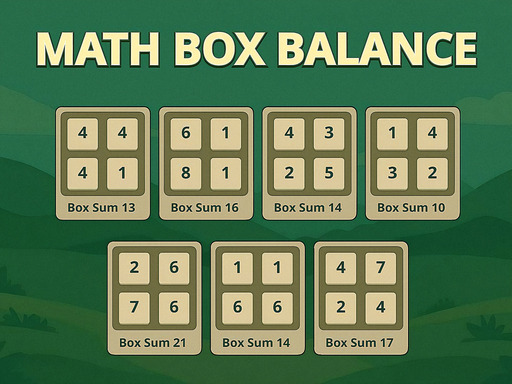
Number Balance Puzzle strips the genre down to one action: swapping blocks so every box totals the same. That constraint works because each swap changes two sums, turning simple addition into a planning exercise. The two-box start teaches the rule quickly, and the climb toward eight boxes adds real complexity without new controls. The absence of a timer suits players who dislike reflex-based puzzles, though anyone wanting story, characters, or competitive modes will find the scope narrow. Its value lies in steady, replayable mental arithmetic rather than variety.
About this game
How the Balancing Works
Each box displays a running total, and your only action is swapping one number block from one box with a block from another. Because a swap changes two sums at once, every move is a trade-off rather than a simple fix. With two boxes, the fix is usually obvious: move a large block out of the higher box and bring a smaller one back. Once four or more boxes appear, a single swap can push one box toward balance while pulling another away, so you have to read all visible totals before committing.
Progression and Endless Play
There are no named stages or a final screen. The game starts with two boxes, then adds more as you clear configurations, eventually reaching eight. Each successful balance triggers a new arrangement, and the difficulty rises gradually rather than in sudden spikes. A score increases with every solved puzzle, giving a simple measure of how many configurations you have cleared. Because the mode is endless, the challenge is less about finishing and more about sustaining accuracy as the box count grows.
Controls and Pace
Interaction is limited to clicking a block and dragging it onto a block in another box; the two swap positions. Visual feedback updates the sums immediately after each swap, so you can see the effect without guessing. No timer runs during play, which means you can study the board for as long as you like. That absence of pressure is central to the design: the game rewards careful observation over quick reflexes.
Who It Suits
Anyone comfortable with addition can play, from children practicing sums to adults who want a short logic exercise. The early two-box rounds teach the mechanic in seconds, while the later eight-box boards demand planning several swaps ahead. If you prefer puzzles with a clear goal, no time pressure, and a difficulty curve that never resets, this format fits that preference. Players who want story, characters, or multiplayer competition will not find those here.
Compatibility
FAQ
Player comments
Sign in to comment
You must be logged in before posting a review or rating.
No comments yet. Be the first to comment!










Editorial Notes